
 |
 |
 |
 |
 |
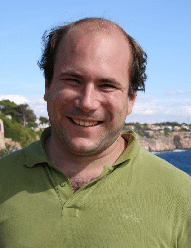 Dr. rer. nat. Gordon Pipa
|
born: |
20. September 1974 |
|
address: |
Institute of Cognitive Science Room 31/404 University of Osnabrueck Albrechtstr. 28, 49069 Osnabrueck, Germany |
|
phone: |
+ 49 541-969-2277 |
|
|
Long CV (pdf)
Short CV (pdf)
Education and Career:
- Habilitation, University of Technology Darmstadt, Germany, 'Self-Organized Information Processing in the Brain'
- PhD, supervisor Prof. Klaus Obermayer, Department of Neural Information Processing, Berlin
University of Technology, Berlin, Germany, Grade 1 (very good)
Thesis title: The Neuronal Code: Development of tools and hypotheses for understanding the role of synchronization of neuronal activity - Diploma, Max Planck Institute for Brain Research and the Faculty of Physics, J. W. Goethe University, Frankfurt am Main, Germany, Grade 1 (very good)
- Diploma-Studies in Physics, RWTH-Aachen University, Aachen, Germany
specialized on theoretical thermodynamics, stochastic processes, and information and image processing
Positions
- since 2011 Full professor (W3) and chair of the Neuroinformatics department, Institute of Cognitive Science, University of Osnabrueck, Germany
- 10/2009-2/2011 Substitute professor for Neuroinformatics (W3), Institute of Cognitive Science, University
of Osnabrueck, Germany - 2010 Tenured readership offered, School of Informatics, University of Edinburgh, United Kingdom
- Group leader with Prof. Wolf Singer, Department of Neurophysiology, Max Planck Institute for Brain Research, Frankfurt am Main, Germany
since - Junior fellow (~Junior Professor), Frankfurt Institute for Advanced Studies (FIAS), Frankfurt am Main, Germany
- Research fellow with Prof. Emery Brown, joint appointment: Department of Brain and Cognitive Sciences, Massachusetts Institute of Technology, Cambridge, MA, USA, and Department of Anesthesia and Critical Care, Massachusetts General Hospital, Boston, MA, USA
- Research assistant with PD Dr. Sonja Grün, Department of Neurophysiology, Max Planck Institute for Brain Research, Frankfurt am Main, Germany
Scientific research program:
My research is focused on understanding how information processing and cognitive phenomena can arise from the collective self-organization of elements interacting across many spatial and temporal scales. In particular I study, first, synchronization of neuronal activity in delay coupled systems, second, information processing in self-organized complex systems in different dynamical states, i.e. self-organized criticality, and third, the use of time series analysis to understand how information flow can take place between neural activity occurring at different spatial and temporal scales. The long term goal of my research is to identify principles that shape neuronal activity and are used to process information in a multi-scale system like the brain.
I firmly believe that understanding the principles of neuronal information processing requires the combination of theoretical, computational and experimental approaches. Therefore my research is multidisciplinary and is composed of two tracks. The first track develops and uses analytical and computational models to identify and understand principles. The second track is data driven and aims to characterize neuronal activity and collective behavior based upon the experimental work of my group and also upon that of international collaborators.
My modeling activities have three main thrusts: first modeling networks and emergent properties, second rhythms and synchronization, and third neuronal computations based on self-organizing systems. In the first thrust I model networks of neurons or neuronal masses assuming that emergent phenomena are inherently important for understanding neuronal dynamics and information processing. In other words, the whole is more than just the sum of simple building blocks. Second, rhythms and synchronization seem to be an omnipresent feature of neuronal activity. Especially the interaction of excitatory and inhibitory sub populations has been demonstrated, by both theory and experiments, to be a crucial element for rhythm generation and synchronization in local populations. Based on this, I focus my synchronization research on establishing concepts and models for synchronization among such local populations that are coupled by large delays. A key element in this research is the use of the network topology to stabilize subsets of synchronization solutions, i.e. zero time lag or near zero time lag. In one of our most recent papers published in PNAS we demonstrate that a certain topology, here a V shape motif that is often found in thalamo-cortical, cortico-cortical, and inside local cortical networks of neurons, can stabilize zero phase synchronization independently of the coupling delay. Third, the neuronal system comprises a large diversity of elements that define various temporal and spatial scales. The self-organization of the system and the resultant dynamics have to cope with or even take advantage of the multi-scale nature and diversity. While in a traditional view such complexity is often seen as noise or an unwanted feature I am interested in principles of neuronal information processing that can take advantage of these properties. Towards this end I identified reservoir computing, originally introduced in the context of echo state or liquid state machines, as a promising concept. Reservoir computing is a universal framework for computation. It uses the dynamics of a complex, maybe random, dynamical system to map features into a high dimensional state, similar to the idea of support vector machines from machine learning. I extended the reservoir computing concept by adding delay coupling and neuronal plasticity to allow for self-organization. Importantly, I do not just aim for describing changes of computational properties, but also for characterizing the underlying principles in terms concepts from physics, such as characterizing the dynamical states regarding criticality, synchronization and consistency in the case of chaotic behavior.
The second research track is data driven and concerns the development and use of new tools for analyzing time series of neuronal data, including spiking activity, local field potentials (LFP), EEG and MEG. The foci of this research track are fourfold. First, detection of synchronous spiking activity, which has over the past two decades turned out to be very difficult. A major complication is how to separate the influences of spike rate and synchronization. My group and I develop tools that allow the identification of synchronous firing and the comparison of the synchronization strength between conditions. Second, to understand neuronal information processing it is important to identify the information flow between different elements, i.e. areas, columns or sub networks of neurons. My research aims to develop and apply tools that allow to identify this information flow, for systems that are both linearly and non-linearly coupled. For MEG, EEG, and LFP data we use directed measures that infer causality based on conditional entropies. To infer the information flow between neurons we use the Point process framework. This is a statistical framework based on the point process likelihood function to relate a neuron's spiking probability to the neuron's own spiking history, concurrent ensemble activity, and extrinsic covariates such as stimuli or behavior. Third, we develop and apply tools to characterize information flow between different spatial and temporal scales, especially between EEG, LFP and spiking activity measured simultaneously. The framework that we are using is also based on the Point process framework. It measures to what degree neuronal mass activity characterized by different components of the LFP or EEG changes the millisecond precise firing of neurons that are part of a network. Fourth, using our tools we can identify undirected and directed coupling to characterize the network for individual states and cognitive processes. To investigate changes of these networks due to dynamic coupling and decoupling we develop and apply tools based on graph theory that allow us to characterize and compare network activity across different experimental conditions.
|
|